
On Wayward Seas
This time, you can bring a hammock. Overhauls Gleba into an archipelagic planet, with expanded planting options for more versatility and a simpler early-game. Boats recommended.
Description
Also known as: Gleba for people who don't like Gleba.
#Dredgeworks and Cargo Ships are recommended as part of the intended experience. Alien Biomes is not recommended (see footnote).
Does not alter the vanilla products of Gleba directly, but substantially recontextualizes them through the world layout and new early alternatives. If you're daunted by Gleba imposing spoilage and pentapod threats at the same time, this mod should ease you into the production processes a lot more.
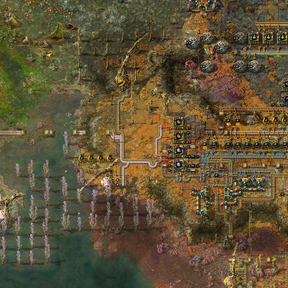
Compatible with Any Planet Start's Gleba start, and appears compatible with Only Gleba as of 0.6.1, though selecting a favorable seed is highly recommended; gallery screenshots are from the APS test game.
Factorissimo is a great pairing as well, especially on higher water coverage where space is particularly tight, and the Ironclad is majorly beneficial for fighting your way into new regions before you have access to more sophisticated weaponry.
Fish Traps is a neat way to get local fish if you're using another mod that very much wants them sooner rather than later.
Balance of new plants and adjusted worldgen is still open to adjustment; thoughts welcome.
If you have an existing world from 0.7.2 or earlier, or a vanilla world, please see the footnote.
World Generation
The influence of Gleba water coverage on terrain elevation is substantially retooled, with the coverage scalar altering land distribution of the world you receive. This has a heavy bearing on how things will play; default coverage has been tuned substantially since initial release and is now the recommended setting if you're not sure what to pick, but you should try higher or lower settings in map generation view to see how they affect things.
- All water coverage scales are guaranteed to have a chunk of highlands in your starting area as a base of operations; it'll vary somewhat in size and contiguity, but serves as a reliable construction area to utilize until you have refined concrete production online.
- At default (100%) water coverage, you'll receive a "balanced" archipelago sizing - it typically has a good amount of wetland you can reach on foot, and is unlikely to have pentapod nests which will put immediate pressure on you. A special component in the starting area generation will attempt to give you an isolated island providing safety against expansion; if you'd like to ensure you have a cozy experience, check your seed to make sure you have a contiguous "moat" around the starting area and a few solid patches of fertile soil.
- Increased water coverage will gradually submerge the non-starting islands, whittling land into shallows and shallows into ocean. This can make it easier to defend against pentapods due to constricting or entirely severing island chain connections. To compensate for the loss of total land area, fertile wetlands and soils become more frequent as water coverage increases (can be disabled), with the most extreme coverage leaving you with virtually nothing but ocean and lush planting areas.
- Lower water coverage will instead raise more land, retaining large bodies of water but gradually connecting landmasses and raising typical altitude, introducing more highlands in the process. Going all the way to 17% coverage will merge almost all landmasses and introduce vanilla-sized highlands, with only a few remaining islands, and pentapod expansion will occur essentially unimpeded.


With Dredgeworks installed, stone can now generate underwater along island coastlines, requiring seafloor drills for extraction. These stone deposits are not quite as rich compared to those you'd find back on Nauvis (though they do grow richer with distance from the starting area), and can't benefit from the yield bonus of big mining drills, but nevertheless serve as a useful source of the material; you'll likely want to have a way to bring stone harvests into a central hub and keep relatively little infrastructure at the mining site itself.
Some further changes provided by Dredgeworks are the ability to directly place refined concrete as a landfill alternative (it's much more resource-efficient, and setting up production for it should be a high priority in advance of base expansion) and the option to create floating belts and inserters (the former of which is quite useful for cultivation in the shallows).
Cultivation
Three Gleban species - cuttlepop, sunnycomb and water cane - have been adjusted to be part of simple production cycles for core resources, which grow in a much wider variety of areas. You will still want to grow yumako and jellynut once you are able to, for the much higher yield and greater product variety they provide (even for metals alone, they yield 13 times the fruit per minute, and each fruit is roughly double the bacteria).

- Sunnycomb is grown in any soil (non-paved) on Gleba, *including landfill*, and yields sunnycomb propagules which can be directly replanted or broken down into three spoilage and two copper bacteria. Harvests occur every eight minutes, producing seven sunnycomb propagules (net yield of six).
- Cuttlepop is grown in any Gleban shallows, and yields cuttlepop pods which can be directly replanted or broken down into four spoilage and two iron bacteria. Harvests occur every four minutes, producing four cuttlepop pods (net yield of three). It's a
Ratings & reviews
Sign in to leave a rating or comment.