Scientific Smithy
Adds semi-realistic and immersive materials science concepts to smithing
Description
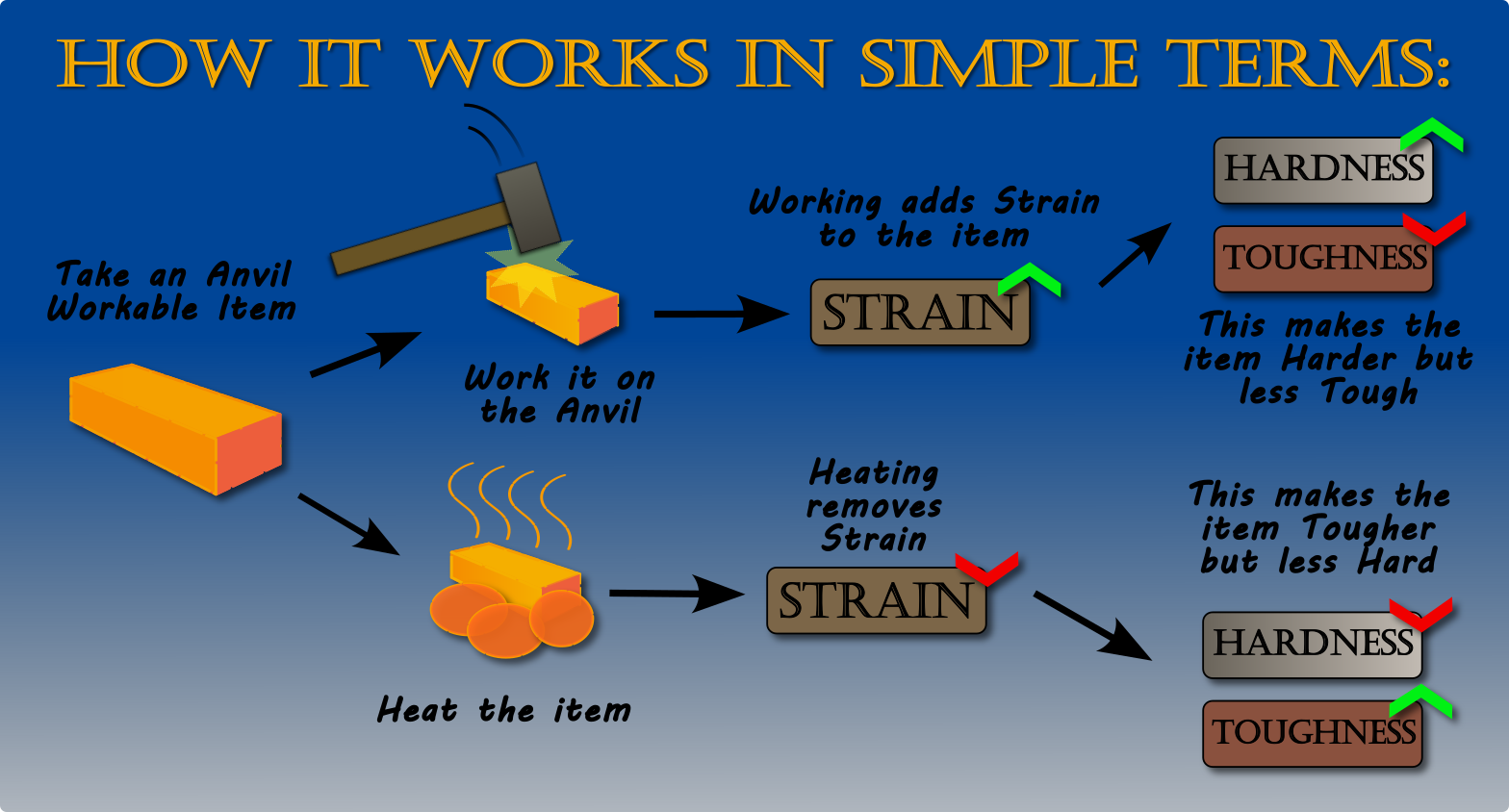
<h2><span style="color: #2880b9;">This mod is for freaks and sickos (like me!) who thought the smithing mechanics just werent complex enough. Enjoy!</span></h2> <h2><span style="color: #e74c3c;">This mod isnt feature complete and is likely to change in the future. Theres plenty to use already but theres still a lot to add. Keep that in mind as you use it.</span></h2> <p> </p> <p>Thanks to <a class="mention username mceNonEditable" href="https://mods.vintagestory.at/show/user/3E2D9D45A15AE4B283A3" data-user-hash="3E2D9D45A15AE4B283A3">JonR</a> for all their help with implementing debbuging and brainstorming ideas for this mod. </p> <h2><strong>Mechanics</strong></h2> <p> </p> <ul> <li>Cold Working metals.</li> <li>Stress-Strain system to determine an outputs durability and effectiveness.</li> <li>Add strain to a piece by working it on an anvil.</li> <li>Recover strain by heating the metal above its recrystalization temperature.</li> <li>Increasing strain decreases output durability but increases effectiveness in non linear way.</li> <li>Adding strain past a metals limit causes cracks on the work piece and may even shatter it entirely.</li> <li>Choose between 3 levels of information visibility: Default, Immersive, and No Help modes.</li> </ul> <h4>Explanation:</h4> <p>This mod adds mainly one thing with vast ramifications: a system for calculating the stress-strain curve of metals in the game. If you arent familiar with stress-strain curves consider getting a Materials Science Engineering degree or looking at this <a href="https://en.wikipedia.org/wiki/Stress%E2%80%93strain_curve" target="_blank" rel="noopener"><strong>wikipedia article</strong></a> (whichever one is cheaper and less soul draining).</p> <p>In short, <strong>items with this system will accumulate strain as they are deformed in some way</strong> (in VS this is mostly hammering them on the anvil) causing them to get <strong><a href="https://en.wikipedia.org/wiki/Work_hardening" target="_blank" rel="noopener">work hardened</a></strong> by this increase in strain. The increase in strain also decreases the <a href="https://en.wikipedia.org/wiki/Toughness" target="_blank" rel="noopener"><strong>toughness</strong></a> of the object and the more strain is accumulated the harder but less tough the object becomes. These values are then used to determine tool durability and speed when the tool is crafted.</p> <p>Every metal has its limits however and so although pushing a metal to its hardest may seem like the best idea, if you go past the metals strain limit, <strong>the piece you are working on will crack and lauch out metal bits</strong> in random directions based on how many voxels get destroyed by the crack. If you try to add even more strain, more cracks will form and you may shatter the piece completely!</p> <p><strong>So how do you decrease strain on a metal?</strong> Well thats simple, just heat it up! All metal items that implement the mod's system have a <a href="https://en.wikipedia.org/wiki/Recrystallization_(metallurgy)" target="_blank" rel="noopener"><strong>recrystalization temperature</strong></a> that is associated with each metal, and heating it up above this temperature will make the metal piece slowly decrease its accumulated strain. The more above the recrystalization temperature the piece is, and the more strain it has, the faster it will have its strain decreased. This is to mimic annealing the metal to relieve stress in real metalurgy. This also means <strong>you can cold work metals if you heat them to at least half of their recrystalization temperature. </strong></p> <p>As you can see, this leads to all kinds of immersive behaviour, between choosing the metal that has the best properties for what you want or is easiest to forge into the desired stats, choosing between a faster but brittle and short lived tool or a slower but much higher durability one. The possibilities for roleplaying and trully mastering the blacksmithing job are enormous! The individual skill of the blacksmith will determine the final product in an engaging and immersive way!</p> <p> </p> <p><strong>Configuration:</strong></p> <ul> <li><strong>"strainPerHit"</strong> - Amount of strain added with a normal hammer hit.</li> <li><strong>"crystalRecoveryRate"</strong> - Base rate of strain recovery when item is above recrystalization temperature.</li> <li><strong>"hitsPerHeavyHit"</strong> - Number of a normal hits' worth of strain a heavy hit adds.</li> <li><strong>"immersiveMode"</strong> - If true displays stress-strain stats in SI units such as Vicker's Hardness(kg/m*m^2) and Toughness(J/m^3).</li> <li><strong>"noHelpMode"</strong> - If true displays only the amount of strain on an item.</li> <li><strong>"displaySettingsGlobaly"</strong> - If true, the server is able to override the stat display settings on the client.</li> </ul> <h2>How it works under the hood</h2> <p>This section is mostly for other modders and people curious how it works at the system level. Its fairly advanced but all the concepts are in links bellow to the appropriate wikipedia pages.</p> <div class="spoiler"> <div class="spoiler-toggle">For the science freaks (Under Construction!)</div> <div class="spoiler-text"> <h4>How it works:</h4> <p><span style="background-color: #2fcc71;">The way it works requires some basic understanding of Materials Science so apologies in advance!</span></p> <p>The way the mod calculates the Stress-Strain curve of a metal is by using the <span class="mw-page-title-main"><a href="https://en.wikipedia.org/wiki/Ramberg%E2%80%93Osgood_relationship" target="_blank" rel="noopener">Ramberg–Osgood equation</a> as an aproximation to real characteristics of stress-strain curves. To do this it takes certain known properties of metals and alloys and plugs them into the equation to get the curve. These properties are:</span></p> <ul> <li><a href="https://en.wikipedia.org/wiki/Young%27s_modulus" target="_blank" rel="noopen
Download
No download link is available for this entry right now.
Ratings & reviews
Sign in to leave a rating or comment.