
Description
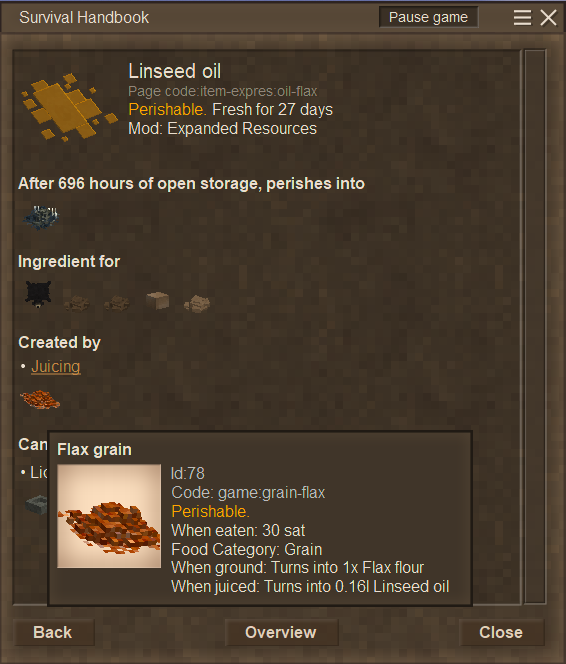
<p><strong>UPD. 14.12.25 - Barbed wire update! </strong>A new fence type made with metal wire items.<br />Barbed wire fences apply a slight damage to animals and creatures touching them, <span style="color: #000000;">except</span> domesticated animals of Generation 3 or higher. Their crafting output is also pretty high, allowing you to quickly fence off large territories.<br />With this update I make my first foray into code modding, so that I can now add more interesting features down the line.</p> <p> </p> <p>UPD. 26.10.25 - Bark update! A whole new production chain utilizing tree bark.<br /><br />This mod adds lots of various craftable resource items to the game and integrates them into existing production chains, drawing strong inspiration from real life recipes.</p> <p>Short list of new resources:</p> <ul> <li>Wood and kelp ashes</li> <li>Starch</li> <li>Soda ash</li> <li>New glue types</li> <li>Oils and rendered fats</li> <li>Soaps</li> <li>Grease</li> <li>Glass batches</li> <li>Metal wire</li> <li>...and more!</li> </ul> <div class="spoiler"> <div class="spoiler-toggle">In-depth list of new resources and recipes:</div> <div class="spoiler-text"> <p> </p> <div class="spoiler"> <div class="spoiler-toggle">Tree bark</div> <div class="spoiler-text"> <p>Tree bark is now a byproduct of debarking logs. Additionally, debarking is now done using a hoe (which is similar enough in look and function to an adze, an actual tool ised in debarking irl) instead of a hammer+axe combination. This makes bark and debarked logs available as early as the Stone Age and gives some extra utility to a previously very underused tool.<br />Tree bark has multiple uses:</p> <ul> <li>It can be burned into wood ash, resulting in half as much ash as you would get from the whole log.</li> <li>Oak and Acacia bark can be used to make tannins the same way the logs are.</li> <li>Bark can be used to make improvised wood armor and a crude shield.</li> <li>Fibrous bark of Birch and Redwood trees can be processed into bark strands which can in turn be used to make many different items.</li> </ul> </div> </div> <div class="spoiler"> <div class="spoiler-toggle">Bark strands</div> <div class="spoiler-text"> <p>Bark strands are a type of fiber that can be used to make:</p> <ul> <li>Bark baskets, bark chests, bark skeps, bark basket traps, rush matting, beenades, hunter backpacks and ropes - all in a similar vein to reeds and papyrus.</li> <li>Bark cordage (a type of thread).</li> </ul> </div> </div> <div class="spoiler"> <div class="spoiler-toggle">Bark cordage</div> <div class="spoiler-text">A type of cordage made of bark fiber, it can be used to make sieves or as a bowstring in the bow recipes</div> </div> <div class="spoiler"> <div class="spoiler-toggle">Starch</div> <div class="spoiler-text">Starch made by sealing starch-rich dough (or rice mash) and water in a barrel. Can be used as an additive in papermaking or to make starch glue.</div> </div> <div class="spoiler"> <div class="spoiler-toggle">Washed flax fibers</div> <div class="spoiler-text">A new processed version of raw flax fibers. Raw flax fibers are now much less efficient when turning them into flax twine, so wash them first if you can. To wash the fibers you need to seal them in a barrel with any kind of detergent (lye, caustic lye or soapy water).</div> </div> <div class="spoiler"> <div class="spoiler-toggle">Raw sinew</div> <div class="spoiler-text"> <p>To compensate for reduced twine yield from raw flax fibers, you can now extract raw sinew from bushmeat, which can then be turned into sinew cordage. Sinew also now replaces bushmeat in the recurve bow recipe.</p> </div> </div> <div class="spoiler"> <div class="spoiler-toggle">Sinew cordage</div> <div class="spoiler-text">Made by combining 4 raw sinew pieces. Can be used instead of flax twine when making bows or leather clothing and armor.</div> </div> <div class="spoiler"> <div class="spoiler-toggle">Wood ash</div> <div class="spoiler-text">Made by burning wood logs in a firepit. Hard woods like beech, maple, oak and walnut produce twice as much wood ash.</div> </div> <div class="spoiler"> <div class="spoiler-toggle">Kelp ash</div> <div class="spoiler-text">Similar to wood ash, made by burning seaweed in a firepit (seaweed plants now drop their own blocks when broken, much like wild vines). Kelp and bladderwrack produce twice as much soda ash.</div> </div> <div class="spoiler"> <div class="spoiler-toggle">Potash lye</div> <div class="spoiler-text">Made by sealing wood ash with water in a barrel. Can be used to soak leather, make soap, as a simple detergent or processed further.</div> </div> <div class="spoiler"> <div class="spoiler-toggle">Soda ash lye</div> <div class="spoiler-text">Similar to Potash lye, made by sealing kelp ash with water in a barrel. Can be used to soak leather, make soap, as a simple detergent or processed further.</div> </div> <div class="spoiler"> <div class="spoiler-toggle">Potash</div> <div class="spoiler-text">Made by boiling potash lye in a cooking pot. Can be used as a P fertilizer, but due to much better availability doesn't give a permanent P boost anymore - that bonus was moved to powdered sylvine, which you can now use directly. Can be dissolved back into potash lye or processed further.</div> </div> <div class="spoiler"> <div class="spoiler-toggle">Soda ash</div> <div class="spoiler-text">Made by boiling soda ash lye in a cooking pot. Can be dissolved back into soda ash lye or processed further.</div> </div> <div class="spoiler"> <div class="spoiler-toggle">Caustic potash</div> <div class="spoiler-text">Made by boiling potash and slaked lime in a cooking pot. Can be dissolved in water in a barrel to create caustic potash lye.</div> </div> <div class="spoiler"> <div class="spoiler-toggle">Caustic soda</div> <div class="spoiler-text">Made by boiling soda ash and slaked lime in a cooking pot. Can be dissolved in water in a barrel to create caustic soda lye.</div> </div>
Ratings & reviews
Sign in to leave a rating or comment.