




About Flow Field Collisions
From Vintage Story ModDBBack-Propagated Flow Field Collisions. Whatever that means.
Back-Propagated Flow Field Collisions
A strange mod that adds weird collisions for questionable reasons.
This is an early release and has not yet been battle-tested in my mods. Use at your own risk.

This mod is meant to be a dependency for other mods, not a mod that is usable in itself.
To be clear: this mod does not add new collisions to existing game objects.
When developing Yang's Transport Tycoon, I had an issue: Since Vintage Story block collisions can't be larger than the extent of a block,
my 2x6 rail pieces could only be broken at a single corner, which was very unintuitive, and also allowed rails to clip through walls and each other.
Unwilling to compromise, I first looked into how the game handled multiple block span collisions, but found that the common approach was to either break
blocks into multiple pieces, to fake their collisions with invisible chiselled blocks, or to use the multi-block system which has limited support for complex/large shapes.
However, modifying the vanilla multi-block works would likely end in a performance and maintainability disaster, as well as damage compatibility with other mods.
So instead, I came up with the idea of 'Back Propagated Flow Field Collisions', a mouthful of a term for a rather simple concept.

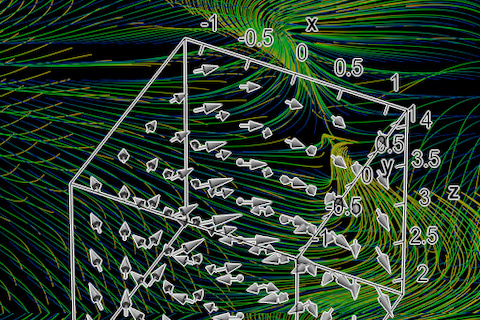
Flow Fields can basically be explained as a grid where every cell points in a direction, that direction being the next cell
that has the most direct route to a discrete point in our grid. This means that if you follow the direction of any cell throughout our grid,
you'll always end up following the most efficient path towards our target cell.
This is a really efficient way of having a very large amounts of points in space which direct to the same goal.
Not only that, but they can be baked (we only calculate them once, instead of querying data each time we need it) as long as the target is static too.
This means that we can have blocks that hold an ultimate direction towards a source block, and as long as we overwrite their behaviour so that
they relay changes to their source, we suddenly have a bunch of separate, discrete blocks which act as one. All-for-one.
Of course, it's not enough for this to be a one-way relationship. When a change happens (like for example, we break one of our flow field colliders) and we
trace our way to the source block to relay the information, then the source block back-propagates the information to all the flow field cells pointing at it. One-for-all.
The key here is that our collision blocks are generic, they just relay data without themselves knowing who the source is, or being understood by the engine as part of a wider self.
This makes the blocks very efficient to store in memory, since they're just generic blocks like dirt or cobblestone. You can have millions of these blocks without barely any additional cost.
The real cost is offloaded to the processor, which has to iterate through our flow field and pass along data, and when back-propagating, potentially perform as many as twenty iterations,
a modern computer processor can roughly handle a couple million iterations each second assuming that each iteration consumes an abnormally inefficient amount of cycles to complete.

Thus, this set-up provides us with a way to create multi-block gestalts while keeping memory costs low and only intermittent (on demand) processor costs.
All for one and one for all.
Why Use BPFFC Over Multi-Block
You should not. In 99% of cases, the vanilla approach is superior (and better supported). It's why vanilla uses multi-block and not this.
This solution is only meant for the edge cases that multi-block refuses to handle, such as blocks larger than 5x5x5, or with complex shapes.
Case in point, if you need a chest, a door, a small raft, or any block that's small and can be shaped as a rectangle, use the vanilla multi-block.
But if for some reason you are tempting god by making blocks that have bendy-straw-like shapes or are very large in size, you can relegate yourself to my solution.
On paper BPFFC is also slightly more efficient, so if your block is meant to be placed in the thousands (like a rail would), then it's a reasonable fit too.

How To Use
Highlights
From source dataGame versions
Built for Vintage Story 1.21.6.
Footprint
Rated a light load on a server.
Flow Field Collisions on Nxeon
From our catalogue- One-click install
- Supported on Nxeon Vintage Story servers. We download it from Vintage Story ModDB, place it, and restart the server.
- Server side
- Required on the server
- Server load
- light
- Smallest plan we suggest
- Vintage Story — 1 GB (1 GB RAM). This follows our own load rating above, not a benchmark.
Run Flow Field Collisions on a Vintage Story server
Pick a server or deploy a new one above; it is installed in one click.
What kind of mod it is
From the catalogQuality of life & UI
Small conveniences, tweaks and interface improvements players notice straight away.
Runs on your server
From source side supportVintage Story ModDB lists Flow Field Collisions as required on the server. Check its Vintage Story ModDB page to see whether players need it too.
Compatibility
- Game
- Vintage Story
- Runs on
- Serverrequired on the server
- Game versions
- 1.21.6
Verified at the source
- ✓Vintage Story ModDBOfficial listing, checked 2026-09-24
- ✓AuthorYangWenLi, as published on Vintage Story ModDB
- ✓LicenseNot published by the sourceFree